I’ve spent a lot of time recently going deep on backlink strategy, and the more I look at how AI-powered search engines actually process and evaluate links, the more I’m convinced that the old conventional wisdom needs a serious update.
The Rule We’ve All Been Following
For years, the backlink game had one dominant rule: dofollow links are gold, nofollow links are noise. The logic made sense in the PageRank era — dofollow links pass “link juice,” help your domain authority climb, and push your rankings up. Nofollow links, commonly found in blog comments, forums, press coverage, and user-generated content, were seen as dead weight. Most link builders treated them as acceptable byproducts at best, and a waste of time at worst.
That thinking is increasingly out of step with how search actually works in 2026.
How AI Search Engines Read Links Differently
The big shift is this: AI-powered search engines — Google’s AI Overviews, Perplexity, ChatGPT, Gemini — don’t evaluate links purely through the lens of PageRank authority transfer. They scan the entire web for context, entity relationships, and trusted citations, treating links as signals of recognition rather than just pure authority juice.
In that framework, a nofollow mention from a respected industry forum or a PR placement in a news outlet carries real weight. It tells the AI model that your brand is being talked about naturally, in diverse contexts, by real people and publications — not just editorially linked by a handful of carefully cultivated sites.
What the Data Shows
A 2025 Semrush study of 1,000 domains found that nofollow links correlate almost identically with AI visibility as dofollow links — a Pearson score of 0.340 for nofollow versus 0.334 for dofollow, and Spearman scores of 0.509 versus 0.504, respectively. The gap is essentially negligible.
Digging deeper, ChatGPT and Gemini actually favour nofollow links slightly more, while AI Overviews and Perplexity lean slightly more toward dofollow links. The takeaway? If you’re optimising purely for dofollow and discarding nofollow opportunities, you’re leaving visibility on the table across multiple major AI platforms.
The Problem with Dofollow-Heavy Profiles
A link profile that’s overwhelmingly dofollow — especially with predictable anchor text and link types — can start to look unnatural to AI systems, which may flag it as over-optimised or manipulated. This is a meaningful risk. AI models are increasingly sophisticated at distinguishing between a genuinely authoritative, widely recognised entity and a site that has engineered its authority.
A site with too many dofollow links and no real nofollow diversity can appear invisible in terms of natural web presence — the kind of organic mentions that happen when real people in forums, communities, and media outlets talk about a brand without any link-building campaign behind it.
What “Balanced” Actually Means
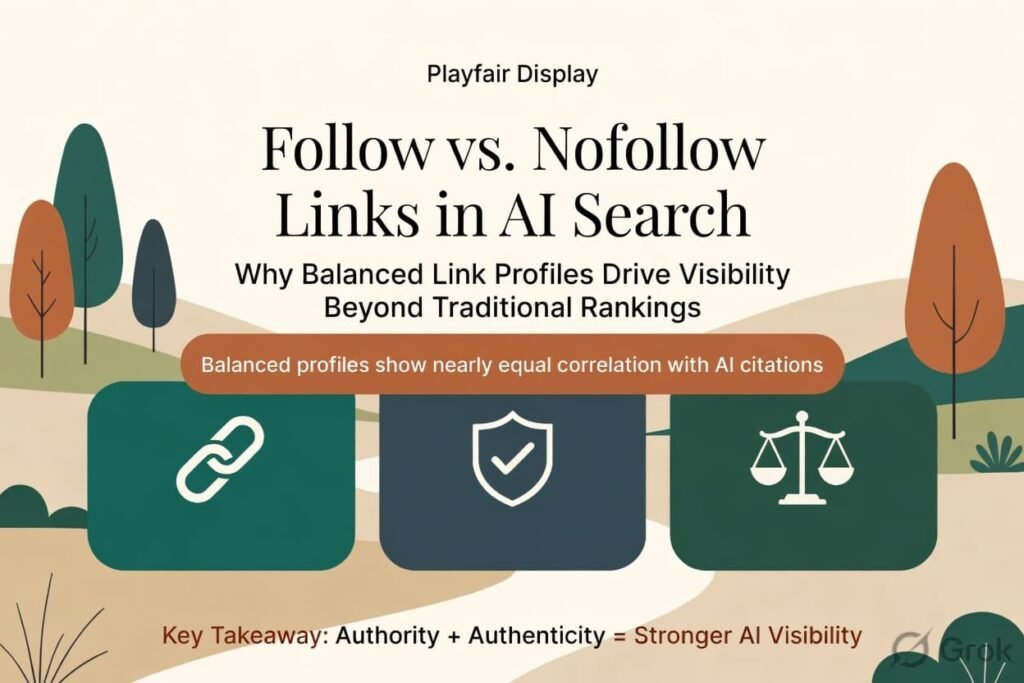
A balanced backlink profile doesn’t mean abandoning your dofollow strategy. Dofollow links from high-authority, editorially relevant domains remain extremely valuable and continue to support both traditional rankings and AI visibility. The point is to stop treating nofollow links as unworthy of deliberate effort.
A rough guide is to aim for around 60–80% dofollow and 20–40% nofollow, with natural variance across link types, anchor text, and referring domains — the goal being a profile that looks like the product of genuine editorial activity rather than a manufactured campaign.
Practically, that means:
For dofollow: Original research and data studies that earn editorial links, guest posts on niche-relevant publications, expert roundups, and journalist outreach through platforms like HARO.
For nofollow: Active participation in Reddit threads, Quora answers, and industry forums like Talking City and India forums. Digital PR campaigns that land mentions in news outlets. Podcast appearances. Even Wikipedia citations — typically nofollow — carry entity-building weight when they’re relevant to your niche.
Why This Matters for Topical Authority
The sites that are performing well in AI search right now aren’t just thinking about ranking power — they’re thinking about entity recognition. AI models use both dofollow and nofollow links to map topics and verify facts. A link indicates that a source is connected to a particular idea, and together, both link types build the entity graph that helps AI understand who you are, what you know, and why you matter.
This is a fundamentally different mental model. Instead of asking “how do I pass the most link equity to my target pages,” you’re asking “how do I ensure that across the entire web, the signals consistently tell a coherent, credible story about my brand’s expertise and recognition?”
How AI Models Combine Both Link Types — and What Practitioners Are Seeing
AI doesn’t ignore one type in favour of the other. It combines signals. Dofollow links provide authority weight, while nofollow links add diversity and real-world proof. The mix helps models decide you’re a legitimate, well-recognised source. Without both, your profile can look artificial, and AI may overlook you in favour of more natural-looking competitors.
This is exactly the approach that the team at Megrisoft has been applying across client campaigns. As an India, United States and London-based digital marketing agency with over two decades of experience, Megrisoft works with brands on AI-search-focused strategies that go well beyond traditional link building. Rather than chasing dofollow metrics alone, their work in Answer Engine Optimisation (AEO), Generative Engine Optimisation (GEO), and Digital PR is built around the principle that a brand needs to be genuinely recognised across the full web — in forums, media outlets, communities, and editorial publications — not just ranked. The results they’ve seen reinforce what the data shows: balanced link profiles that combine strong editorial authority with consistent nofollow mentions from trusted, natural sources lead to measurably better citation rates in AI-generated answers on platforms like ChatGPT, Perplexity, and Google’s AI Overviews.
Real-World Results
One mid-sized SaaS company saw its AI citations jump 180% after a PR campaign that generated 40 high-authority nofollow mentions alongside ongoing dofollow guest posts — traditional rankings barely moved, but ChatGPT and Perplexity started referencing them regularly.
Another e-commerce brand with an over-optimised, dofollow-heavy profile cleaned things up by adding natural forum and Reddit links and saw AI visibility improve within weeks while also reducing their penalty risk.
The Bigger Picture
Link building won’t disappear, but it will keep evolving. AI models will rely more on contextual signals, entity relationships, and multi-source validation. Unlinked brand mentions, image links, and video citations are also expected to gain more weight over time.
The brands winning this era are the ones treating link building as a form of brand building — less about gaming a ranking algorithm and more about becoming a genuinely well-recognised, widely-cited entity across the full spectrum of the web.
If your current backlink strategy is still laser-focused on dofollow acquisition and treating nofollow links as an afterthought, it’s probably worth auditing your profile and thinking about where your natural, community-level presence is actually being built. That’s increasingly where AI search visibility is being decided.